Equipping Ministers with a Bible Study Tool Belt

Bible Tool Belt white paper PDF

Grow your Ministry using Social Media.

Techniques to connect with more people to grow your ministry using social media. Developing an effective strategy for Social Media ministry to successfully focus on the appropriate overall ministry goals. 

Posted in pastor’s, Speaking | Tagged , | Leave a comment

“In-N-Out” Bible Study 7: 1 Corinthians 13:13

in n out car

And now these three remain: faith, hope and love. But the greatest of these is love. 1 Corinthians 13:13:  

Open Q: How does this passage motivate you? What do you think? 

Main Point: God’s character is love and He loves you and accepts you; you are forgiven and secure in Him!  He created you for a reason and has given you a purpose greater than you could ever imagine. He wants you to pursue Him and His principles so He can empower you even more.  

What does this mean?  God tells us that love is the greatest thing we can experience, that real love points to Jesus, for He is the Greatest!  God loves us so much; He will allow His great love to move in with hope to further our faith.  When we are in Christ, we have deep value. He died for you to give you salvation so you are unique and complete in Him!  When we have faith in Christ, we are pleasing and glorying Him, which is the main mission for our life.  With faith, you will be able to move forward this great love and all of its dimensions to impact the Kingdom!  

What can we do?  Take each of the aspects of Love in 1 Corinthians 13; then replace the word “love” with “Jesus!”  For example…Jesus is patient, Jesus is kind…; what does this do for you?  How does this give you a glimpse into His character? 

Challenge Questions: 

Q: Why is real, authentic Love the greatest thing we could ever have or do? 

Q: What do faith, hope and love mean to you? How have you shown them?  

Q: How would a better understanding and practice of love help you? 

How does this apply? The manifestation of love places our confidence in our Lord, that He is holding and molding us, and the expectation that we have more and better things to come throughout all eternity. Hope is not just our forward outlook to be in Christ forever, or that produces Joy for today. 

Where is my Hope in this? We do not deserve His love, yet we receive it anyway. We do not earn it or achieve it or merit it in any way whatsoever, yet it is there for our taking because of what Christ has done on our behalf.


Posted in Bible, Speaking | Tagged , , , , , , , , , , , | Leave a comment

“In-N-Out” Bible Study 6: John 14:6

 in n out sgn

Jesus answered, “I am the way and the truth and the life. No one comes to the Father except through me. John 14:6 

Open Q: What causes you to fear or fuss or fret or stress? What do you think? 

Main Point: Jesus is the way to the Father. Jesus is exclusive, the only Gate to God! This is not just knowledge of God, rather an intimate connection that He first offers to us-a unity to us in His work for our redemption. This is also an invitation to radical faith. 

What does this mean? The “way” in Hebrew, refers to the pursuit of righteousness as one journeys through the wilderness of the tough times-even suffering. It is a beacon, and we are to focus on Christ. Truth means He fulfills the Law and teachings of the Old Testament. Life means there is no existence without Him and there is no salvation without His atonement, redemption, and grace. Christians were first called “the Way” (Matt. 7:14; John 1:1-4, 14; 3:16-18; 5:26, 33; 11:25-26; Acts 4:12; Eph. 2:8-9; 1 John 5:12).  

What can we do? Look to Christ!  All the blessings and wonder that we have and can have are locked up in Christ and He gives us the key of faith turned by our faith, commitment, and obedience.  

Challenge Questions: 

Q: What does it mean to you to Trust in God? 

Q: What can? 

Q: What do you lack to have more of a commitment to faith? 

How does this apply? There is only one True God and only One right way; Jesus is that Only way and path to God, Heaven, and real righteousness!  We do this in Christ alone by faith alone. No other aspect of what we can do such as “works,” can give us merit; rather, our salvation is the result of His working in us (John 1:23; Rom. 1:16; 10:4-17; James 2:14-26). 

Where is my Hope in this?  We can trust in Him totally and completely with all we have now and for our future. He is not just preparing a place for us in eternity, He is preparing us for eternity, too!  Fear, frustration, misunderstanding, expecting something else does not need to consume us. Our wholehearted commitment to faith and obedience to follow it up will be key (John 2:21).


Posted in Bible, Speaking | Tagged , , , , , , , , , , , | Leave a comment

“In-N-Out” Bible Study 5: Proverbs 3:5

Prov 3 5 in n out

Trust in the Lord with all your heart and lean not on your own understanding; Proverbs 3:5

Open Q: Does fear have a hold on you? Are you so busy looking for opportunity you cannot see anything else? What do you think? 

Main Point: Trust in God is a call to a personal relationship with conviction with Christ. This is a command to step up to faith, our response to the call of God with trust in Him through times of danger and fear.  

What does this mean? Yes, we can trust and rely in God with our whole being and with anything that comes our way!  We can have a close relationship with God.  This means to bow down in such surrendered obedience and devotion that we should be overwhelmed and encompassed, so we are totally focused upon our Lord and not upon ourselves (Isa. 8:17; 28:16; Psalm 118:22; John 13:36; Heb. 2:13). 

The theme of Proverbs is that the fear of God is the foundation of learning and growing. This means the awe, worship and reverence we are to have for God. Any fears of rejection or wrong assumptions can dig in and keep us from experiencing and proclaiming our love for Christ (Prov. 1:7; 2:6; 3:5-6; 16:20; 21:1-2; Matt. 10: 27-33; 22:36-38; Phil. 4:12b-13; Col. 2:2-3). 

What can we do?  We can have trust when we combat fear! We can combat fear with fear.  Yes, the solution to fear is fear!  To move from the dread of our circumstances to the trust and reverence of our Lord.  We can grow and embrace the wonders He has for us.  

Challenge Questions: 

Q: Why can there be no neutrality in the Kingdom of God?  

Q: How can you have a life filled with purpose and distinction? What would be a better purpose for you?  

Q: What do you need to do to have a more reverent and fearful attitude toward God?  

How does this apply? We have to learn how much Jesus indeed loves and cares for us so we can trust Him even more to take us beyond what holds us back in life. Then, there is nothing that can hold us back in our spiritual growth or from proclaiming His Word. 

Where is my Hope in this? Jesus is our Sanctuary; He is the Eternal God on whom we can rely and not only give our lives to, but also live our lives for. When we understand that we are precious in His sight and His deep love for us is true and real, we will have no need for fear. We can let go, let God, and allow Him to reign and be Lord over us as our loving Father.


Posted in Bible, Speaking | Tagged , , , , , , , , , , , | 1 Comment

“In-N-Out” Bible Study 4: John 3:16

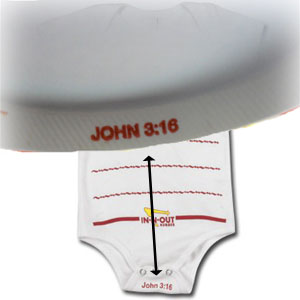
in-n-out jn 3 16

For God so loved the world that he gave his one and only Son, that whoever believes in him shall not perish but have eternal life. John 3:16 

Open Q: What does it take for most people to take hold of His amazing grace?  What did it take for you? 

Main Point: For God so Loved the World!  His great and powerful love is to be involved in your life and give us undeserved Salvation for eternity and hope for today!  Our life is timeless; we are made for eternity, and we can have a good and purposeful life now! 

What does this mean?  Jesus did all the work; all we just reach out and take hold of His hand, miraculous grace!  The main point and purpose of Jesus Christ is not to condemn, but rather to save.  When we realize this, we can trust Him, we can be saved, and He will not allow us to be condemned. (Gen. 12:1-3; Psalm 136:1; Isa. 9:6; 63:9; Matt. 5:44-45; John 1:14, 18; 12:47; Rom. 8:32; 1 John 4:9-10; 5:20). 

What can we do?  Do Not Fear! Those whose faith is in Christ do not have to fear judgment or punishment because Jesus has conquered sin. We receive what He gives and loving it, you will have a better life–a marvelous life here and an amazing eternity beyond description!  

Challenge Questions: 

Q:  How would you describe the love of God from this passage? 

Q: How does this inspire people to either love or hate Him?  What about to help you have faith and trust Him? 

Q: How does the fact you are made for eternity motivate you to have a good and purposeful life now? 

How does this apply? See His love, receive His grace, throw off hate and worry, and put on His love, allowing His saving work to envelop and intervene deeply in you so you are truly and completely saved! 

Where is my Hope in this? We are or we can be saved from sin and for a purpose! This is the passage that everyone knows, that people will either love or hate,. Just as it is with Christ-we either love Him or hate Him! But, whether we love or hate Him, Jesus did, in fact, come into this world to save us.


Posted in Bible, Speaking | Tagged , , , , , , , , , , , | 1 Comment

“In-N-Out” Bible Study 3: Proverbs 24:16

in n out

For though the righteous fall seven times, they rise again, but the wicked stumble when calamity strikes. Proverbs 24:16 

Open Q: What is the cost when we do not strive to overcome our faults or problems? What do you think? 

Main Point: Even though we see wicked people prosper and good people suffer, God will vindicate us. Jesus not only walks by our side, He picks us up and carries us through the times of darkness and confusion. And, those who do wicked to His people, there will be woes to them, and that is not fun.  

What does this mean? God wants us to have the outlook to learn from our mistakes and sin. He wants us to not keep making the same bad choices and mistakes; rather seek and give God glory and obtain success by leaning from whatever we experience and what He has us do (Psalm 1:1-3; 145:14; Mic. 7:7-9; Matt. 6:33; Rom. 7:14-20; 2 Cor. 12:9-10; Phil. 4:12-13).  

What can we do?  We must ask ourselves if we have sin we have personally caused? If so, repent (Rom. 7; 1 John 1:8-10; 2:1-2)!  Find out your weakness and be willing to work to overcome them (Psalm 119:1-5; James 1:5-8, 22-25)!  Do not make excuses; rather, be responsible and make a plan (1 Cor. 10:13; James 1:13; Phil. 4:13)!  Realize that God cares and has a purpose for you even in failure and He will work it out (Psalm 37:23-24; Rom. 8:28)! 

Challenge Questions: 

Q: Why would someone allow disappointment to become their identity? 

Q: How does the fear (respect) of God counteract disappointments? 

Q: What would improve with you, if you had a better willingness to learn and grow from your problems?  

How does this apply?  We can trust in God and ride out our circumstances.  Why?  If God is in control–and He is–then nothing can happen without His permission and as a result, we can take hold of Him to move us forward.  

Where is my Hope in this?  We have no need to fear failure or freak out when life gives us a bumpy ride. Thus, we will not give up where and what we are called to go and do. When we are building our confidence and conviction in Christ, we can have real effective achievements that last into eternity. We can persevere through whatever life and bad times throw at us.  

Posted in Bible, Speaking | Tagged , , , , , , , , , , , | 2 Comments

“In-N-Out” Bible Study 2: Nahum 1:7

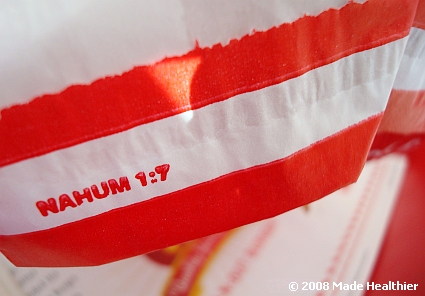
in-n-out-bible-verse nah

The Lord is good, a refuge in times of trouble. He cares for those who trust in him… Nahum 1:7 

Open Q: Do you feel God is distant and does not care about you, your situation, or your concerns?  

Main Point: God is good!  We can have an outlook of enjoyment and real, authentic happiness–even in distress and uncertainty.  What do you think? 

What does this mean?  Our trying circumstances will threaten our contentment and ability to persevere, such as pain, suffering, or loss. In these times our Lord is our Refuge.  We have a call to seek God, place Him first, think through our situation, and plan accordingly to do what is best and what honors God.  We can Trust in the LORD. We must place our faith in God so we have conviction and commitment to know Him and rely on Him (Ex. 14:32; Psalm 4; 37:3; Prov. 3:5; Jer. 39:18; Acts 14:23).  

What can we do?  We can appeal to God to hear us and have mercy. Our call is to show respect for His holiness. God promises us He will come to our rescue, but it will not always be when and what we hoped for. His plan is best, even when we do not see it (Psalm 25:4-5; Isa. 45:13; Jer. 23:6). 

Challenge Questions: 

Q: How do you feel that God promises are not always when and what you may have hoped for?  

Q: What do you need to do to have more confidence in God’s plan even when you do not understand it?  

Q: If you feel your prayers don’t seem to be heard or responded to, what should you do?  

How does this apply? We can have confidence in God. Even though it seems our prayers are not being heard or responded to, the Lord has set apart the godly for His purpose and plan, and He will answer us in His time. 

Where is my Hope in this? Times will improve; but even if they do not, I will trust in God. I know He smiles upon me and loves me; therefore He is my joy even when my situation is not joyful. I have peace and security even when others come against me. My God will keep me safe in Him!

Posted in Bible, Speaking | Tagged , , , , , , , , , , , | Leave a comment

“In-N-Out” Bible Study 1: Revelation 3:20

    rev  3 20 

Here I am! I stand at the door and knock. If anyone hears my voice and opens the door, I will come in and eat with that person, and they with me. Revelation 3:20 

Open Q: How can indifference and the feeling that we do not need Jesus play out in our personal life? 

Main Point: Jesus stands at the door of our souls and of our churches and asks us to open ourselves to Him and His ways. What do you think? 

What does this mean? I stand at the door and knock is an image of our Lord knocking on the door of our hearts and church. He is calling for us to come to Him. The irony is Jesus is knocking on the door of the self-deluded and complacent church who refuses to invite Christ into “their” church or be a part of “their” activities and lives are being called out by Him (Matt. 24:33; Mark. 13:29; James 5:8-9; Rev. 3:11; 22:7).  

What can we do? We are allowed with great privilege to personally commune with the Lord Almighty! We can have a faith that opens His door. By our obedience, it keeps it open, but our pride closes God’s work in us (Luke 12:35-38). What do you think?  

Challenge Questions: This is also an image of a diseased, pious, fraudulent church. What do you think?  

Such a church is just a Christian Country Club where the name Christian is an oxymoron.

 Q: What causes people to think they have no need for Christ? What would that mean to you?

 Q: What can you do to open the door for Jesus?

 Q: How should the leadership, let Christ is to set the direction of your church?

 How does this apply? This was the church of indifference and foolishness, as they thought they did not need Christ. They thought they were good when they were really bad, and they were sad as they had no enthusiasm for Christ. Do not force Jesus to stay outside of your church while He is waiting to enter!

Where is my Hope in this? God loves you and wants in your heart for you to have a life of contentment and purpose!

Posted in Bible, Speaking | Tagged , , , , , , , , , , , | Leave a comment

“In-N-Out” Bible Study, Intro

in-n-out-burger

Revelation 3:20; Nahum 1:7; Proverbs 24:16; John 3:16; Proverbs 3:5; John 14:6; 1 Corinthians 13:13 

In one of our favorite fast-food restaurants, a Los Angeles cultural icon, there is a unique surprise under the drink cups and hidden in the bottom edges of the hamburger wrappers and french-fry trays–a Bible verse. This can be a low key, wondrous opportunity to spread the Gospel while enjoying a fun meal.  Imagine bringing a non-Christian friend to have a meal; what a great discussion starter! Now you have a place to bring a youth group when you have new students while not worrying about it being to overt to offend.  All you do is pick up your cup and say, I wonder why this is here and what does it say and mean?  Look it up, and say it. 

You see, its founders—the Snyder family in 1948–were Christians and wanted to honor God with their business; what a great way to do that. Here are the main Bible passages: 

Where are the In-N-Out Bible Verses? 

  • Hamburger and Cheeseburger Wrappers: Revelation 3:20
  • Double-Double Hamburger Wrapper: Nahum 1:7
  • French-Fry Tray: Proverbs 24:16
  • Beverage Cups: John 3:16
  • Milkshake Cups: Proverbs 3:5
  • Water Cups: John 14:6
  • Merchandising, License Plate and Keychain: 1 Corinthians 13:13

 The “In-N-Out” Bible Study 

Here are several ways to turn your fast food dining experience into a fine dining adventure into God’s Word. 

For each of these passages, all you need to do is read it and ask these eight Inductive Bible Study Questions that apply:  

  1.  What does this passage say?
  2. What does this passage mean?
  3. What is God telling us?
  4. How can we be challenged so we can learn and grow?
  5. What is in our way with listening to God?
  6. How does this passage apply to us?
  7. What will I do about this?
  8. What does God want me to share with someone?

 All these passages point us to Christ, that our God has steadfast love for us and is here, even when people make difficulties and barriers against us.  When we feel distressed and confused, when we wonder if this is worth it–if this is all there is in life, God is here—always.  And, this is what He is saying:

© 1989, 2013 Rev. Richard J. Krejcir, Into Thy Word Ministries www.intothyword.org

Posted in Bible, Speaking | Tagged , , , , , , , , , , | Leave a comment

How is Love Spelled Out in the Bible?

What is real love about according to the Bible?  

One of the teachers of the law came and heard them debating. Noticing that Jesus had given them a good answer, he asked him, “Of all the commandments, which is the most important?” “The most important one,” answered Jesus, “is this: `Hear, O Israel, the Lord our God, the Lord is one. Love the Lord your God with all your heart and with all your soul and with all your mind and with all your strength.’ The second is this: `Love your neighbor as yourself.’ There is no commandment greater than these.” Mark 12:28-31 

In the Old Testament, the Hebrew word most often used for love is hesed, it refers to a covenant of love that is promised or owed (Hosea 1:1). Sometimes, it refers to being merciful (Psalm 23:6). 

Throughout the centuries, Jewish commentators have stressed that it is God’s love for Israel. It basically means because God promised to love you, you must (as in He commands it) respond in kind to others around you in His covenant (other Jews). It is a replicable relationship formed by God’s covenant with us; thus, we respond to others as God has chosen to deal with us. Even in the Old Testament, this love could not be forced or compelled even though it was commanded; rather, it was freely and gracefully given. That is how God deals with us—freely and graciously. It is a love, not based on feelings, but a choice, as in marriage, to say I do and follow through with I will—not only if I feel like it!  

This is what it means to Christians under grace: because God loves me even though I do not deserve it, I can respond to His love in appreciation by loving others He has chosen to love. That is, He loves us so we are to love others, even though we do not have to. 

In the Greek, there are four words that we translate as love, two of which are found in the New Testament. The four words are agape, phileo, eros, and stergo 

The first is phileo, which means to have a brotherly love for others. It implies a deep-rooted affection. It is from the Greek, which means brotherly love, and is where we get our word for the City of Brotherly Love, Philadelphia (Matthew 19:19b). This word implies that we go beyond superficial relationships and strive for the deep ones, without being shallow or pretentious (Matthew 5:44).  

The second word for love in the Bible is agape. This word was used in classic Greek literature to refer to someone who was generously favored by a god. It conveys the idea of a person giving all of his or her love, or favor, to someone else other than one’s self. It is a love of self sacrifice and response (John 21:15). It is a love that is not earned; rather, it is given freely. It also refers to parents giving all of their love to their child. In the New Testament, agape love is used to make a similar point, as God gives each of us all of His love.  

Agape is also the most common word used both as a noun and a verb in the New Testament. The greatest example of agape love is what our Lord Jesus Christ did when He died for our sins. God showed His love by taking our place, and the wrath and punishment for our sins. He paid that price through His sinless life, and His sacrifice on our behalf. Consequently, God’s agape love rescued us from the punishment that we deserved. We deserved punishment, yet, we received His favor without earning it.  

There are two other types of love in the Greek that are not found in the Bible.  

The third one is eros, which usually refers to sex, and the love between a husband and wife. It is more than just sexual ecstasy because, in classic Greek, it also includes embraces, yearning, and caring. But, in passages such as Ephesians 5:25 where we are called to love our spouse romantically, the word used is not eros, rather, agape! So, as a Christian, we are to have a deeper love than what we see in the media and society, one that is not based on eroticism. Eros has noun and verb forms that we find in the New Testament for lust, such as epithumeo (1 John 2:16).  

The forth love that is popular in evangelical circles is stergo, and, this is not in the Scriptures either. It normally refers to the love between parents and children, or the love between people and their leader who has responsibility over them, from parents to civic authorities. What we learn from these Greek words agape, and phileo, used in the Bible, is their emphases of real, authentic love, without pretensions or expectations (1 John 4:7-11).  

These last two words imply strings attached, expectations needed to make them work. They refer to lust, which is a pretender to love, which is the reason they are not used for love in God’s most precious Word. They refer to a connection that must already be there, such as a parent and child. The parent does not love another’s child as they do their own.  

We may know all about love as Christians from books and sermons, yet still half of us get divorced. Thus, we may know about it beyond knowledge and insight; but, we are not being wise with it. We are not applying real love into our lives, connections and marriages! Let us look to God’s Word and ask ourselves am I applying this and if not why and how can I 

Christian love is the turning of our backs to self-concerns, and facing forward to our relationships with family, friends, and neighbors. It is the surrender of our will to His. Because, if love does not take us beyond our self-interests, then what we have is lust, and not love! Then, as the passage says, we are just noise that has no reason or purpose.  

Out of true love, God the Father gave us His Son, and the Son gave us His life as a replacement for ours. The Son sent the Spirit to save us, and we should be literally overwhelmed—consumed with extreme joy and gratitude by what God has done for us. Then, that can turn and spill onto others around us. If not, then read Romans 1:21!  

They key to all of this? Be willing to apply love and respect the other person and stay committed to these precepts of love!  

Ephesians 5:33 states, However, each one of you also must love his wife as he loves himself, and the wife must respect her husband. God’s Word gives us the plan; we have to be willing (the hard part) and capable (what we already have at our means) to carry it out. Love and respect traverses genders and crosses lives and must cross yours by His Cross to others too!  

Questions to Ponder 

Remember we do not deserve His love and grace, yet it is given to us anyway. 

Read Romans 5:8;; 1 John 4:7-21 (if time, 1 Corinthians 14:1a; Colossians 1:3-8; 1 Thessalonians 5:8) then discuss this section and answer these questions:

 What do these passages teach us about love? 

  1. Is there something that one or more of these passages are saying to you, perhaps something that needs your attention? 
  2. How do you feel that love is not based on feelings, rather a choice? How does that work?  
  3. Have you considered that the definitions of the love languages in the Bible is how God deals with us—freely and graciously 
  4. What role does love play in relationships, in general? What about in your relationships? 
  5. Do you believe you can find God’s real purpose and plan for your life? 
  6. Do you have confidence that there is a Divine plan for you? If not, where do you place your hope and trust? 
  7. What can you do to make sure you do not forget, so that these passages stay with you, always? 
  8. Is your attitude and relationship with Christ employing and empowering you, or, is it your Will and determination?
  9. What will your life look like with these love ‘attitudes’ working and infusing all that you are and do in your life? What would your workplace look like? What about church, marriage, friends, family…? 

Do not love the world or anything in the world. If anyone loves the world, the love of the Father is not in him. 1 John 2:25 

Consider this: Without the right attitude and perspective on life, without glorifying God, and following His Will, you will not find the real quality love relationship for your life! You will be taking a gamble with what is priceless and precious, that you get it right. 

© 2013 R. J. Krejcir, Ph.D. Into Thy Word Ministries www.intothyword.org 

Posted in Fruit of the Spirit, Sermons | Tagged , , , , , , , , , , , , , , | Leave a comment